Beautiful Things

A few days ago, while talking with a good friend, he told me he had started letting Claude, in agent mode, handle entire development tasks on its own. With a tone somewhere between resignation and surprise, he said something like: “The bastard even writes code that looks beautiful.”
I kept thinking about that sentence longer than I expected.
He didn’t say “efficient.” He didn’t say “correct.” He said “beautiful.” And he said it without trying to. Like someone describing something that happened to him before he had time to explain it. That is exactly what beauty does: it arrives before thought. You don’t decide it. You feel it.
The Pursuit
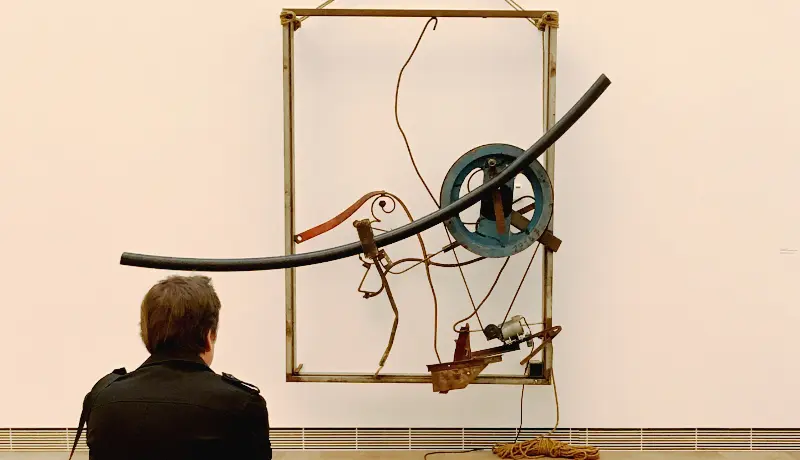
There’s a Jean Tinguely piece I can’t quite remember anymore. In any case, I visited his museum in Basel, and what stayed with me was not the image of a specific piece but an experience: machines moving, making noise, sometimes destroying themselves. Engineering without purpose. Movement without anywhere to go.
Tinguely spent decades building objects searching for something that does not exist. And inside that impossible search lives all the beauty. Not in the result, but in the gesture of continuing to move.
I think beauty works the same way. You chase it. You never really get there. And perhaps that is the point.
What You Feel Before You Understand It
On April 3rd, 2018, Cristiano Ronaldo scored a bicycle kick at the Juventus stadium. They were already winning. The man could’ve just calmed down. Instead, in a fraction of a second, he chose pure aesthetic instinct: the body suspended in the air, the impossible angle, the exact moment. What followed was spontaneous. Juventus supporters — the opposing crowd — stood up and applauded. Nobody decided to do it. It was an involuntary response to something they recognised as beautiful, even if it hurt.
Photography can work in a similar way. Martin Argyroglo was not a news photographer. He attended the Paris march on January 11th, 2015, and posted a photograph on social media that same night simply to participate, with no intention of selling it. The scene: the Triumph of the Republic statue as the axis, flare light cutting through smoke, protest signs layered like fragments of text. The next day, it became the cover of L’Obs in 610,000 copies. He did not construct the scene. He recognised it. In fractions of a second.
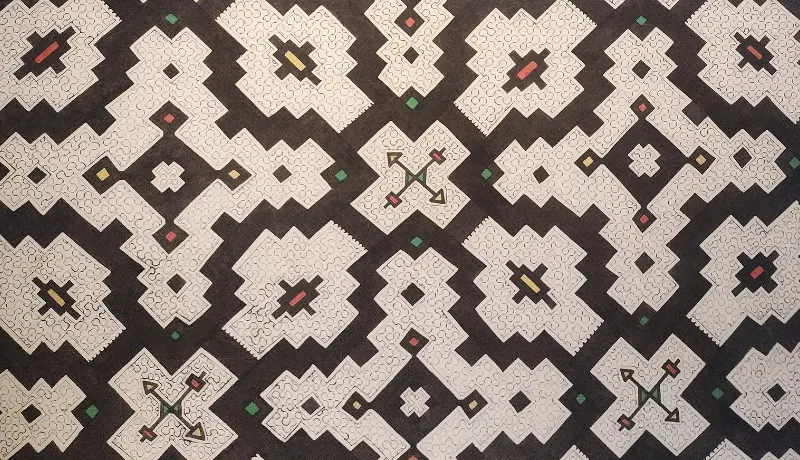
Among the Shipibo-Konibo people of the Peruvian Amazon, the word kené means design. But it comes from the verb kéenti: to love, to care. Sara Flores has spent decades tracing geometric patterns on wild cotton fabric using vegetable dyes, without sketches or any digital process. She says that at some point, “the hand moves on its own.” For her people, illness is a lack of aesthetic harmony. Beauty is, literally, health. It is not decoration. It is the order of the world.
To feel before understanding.
The Sea of Options
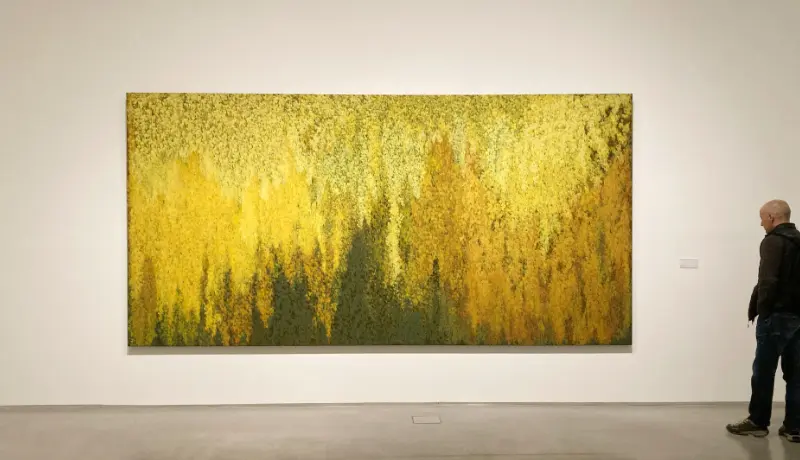
Soledad Sevilla has spent sixty years painting the same painting. She says it herself, without apology: “It is a theory many artists share, that we are always painting the same painting.” It is not a confession of limitation. It is a declaration of method. I saw her work at the Reina Sofía Museum, and what her canvases produce — overlapping geometric structures, hand-drawn lines that vibrate — cannot be understood up close. You have to step back. Then something changes. The grid becomes light.
When asked whether she imagined herself working with AI, she answered: “No. I returned to graphite and paper. The pleasure of the blank canvas, of the hand… that personal relationship between the work and yourself is what satisfies me most.” Eighty years pursuing the same thing. That too is beauty.
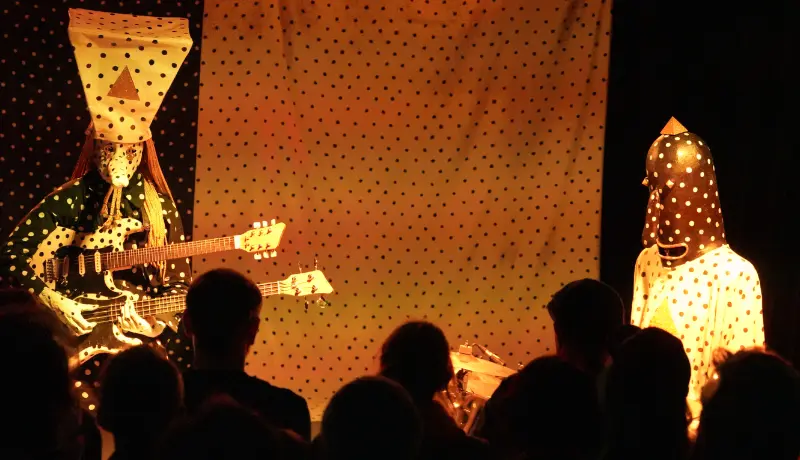
Angine de Poitrine, a duo from Quebec wearing papier-mâché masks, makes microtonal math rock that nobody asked for and that nobody can replicate, not even AI. Someone once asked Suno to generate music in their style, but got conventional progressive rock instead. What they create comes from twenty years of playing together, from absorbing scales that do not exist within standard Western notation. Form followed necessity. Always.
In 2003, WordPress decided its public identity would be an aesthetic statement: Code is Poetry. The implication was clear: writing good code is not only about solving problems — it is also an expressive act. Badly written code that still works is bad prose. It functions, but something in it offends.
We have more tools than ever before. More references, more options, more speed. And paradoxically, that makes the search harder. Not because we lack means, but because we have too many. The abundance of options dilutes judgment. When everything is possible, producing becomes easier than pursuing.
Where Nobody Asked for It

Steve Jobs insisted that the inside of the original Mac — the boards, the cables, the chip arrangement — should have the same level of design quality as the exterior shell. His engineers protested: nobody would ever see it, the case would remain sealed. He answered that they themselves would know. That was enough.
In system administrator forums, there is an unofficial photographic genre known as cableporn: cable installations organised with absurd precision and care. Nobody really asked for this. Nobody sees it. It does not improve the signal. Someone bent every curve carefully because they could not do it any other way.
In both cases, beauty appears where there is no audience. No client commissioning it. No brief. It is an internalised judgment to the point of becoming involuntary.
Returning to the Initial Idea
Claude writes beautiful code because it has absorbed enough patterns, enough structure, enough accumulated “before” for something resembling judgment to emerge as a byproduct. It does not seek beauty.
What is unsettling is not that an AI can write beautiful code or generate a perfectly lit image. What is unsettling is the question this opens: how much of what we call aesthetic judgment is simply accumulated exposure? And how much of it is something else entirely — something tied to wanting, to kéenti, to caring about what you make even when nobody sees it?
I do not have an answer. But I do have the feeling that the difference between those two things is exactly where the kind of beauty worth chasing still lives.
Claude, Grammarly, ChatGPT and, every now and then, Gemini helped me cross-check information and refine parts of the structure, grammar and flow of this text. If any hallucinations remain, they’re most likely mine.